
The web is great at telling you what people said about a rule. It's a lot worse at telling you what the rule actually says.
Ask about a regulation, a company filing or a government dataset and most of what comes back is a law firm alert, a news story, or a blog post summarizing somebody else's summary. Some of those are right. Some of them quietly turned "proposed" into "final" two retellings ago. Farside grades every source it finds, but it can only grade what search hands it.
So as of today, Farside can go straight to the record. There's a new option on every run called Search official public records, and it's live for every customer.
#What it does
Turn it on and Farside picks the official sources that fit your question, fetches the records, and grades them like any other source. Nothing gets a free pass for having .gov in the address. The records that hold up get cited in the report right next to your web sources, with shaded citation numbers so you can tell them apart at a glance.
You can let Farside choose the sources, or pick them yourself.
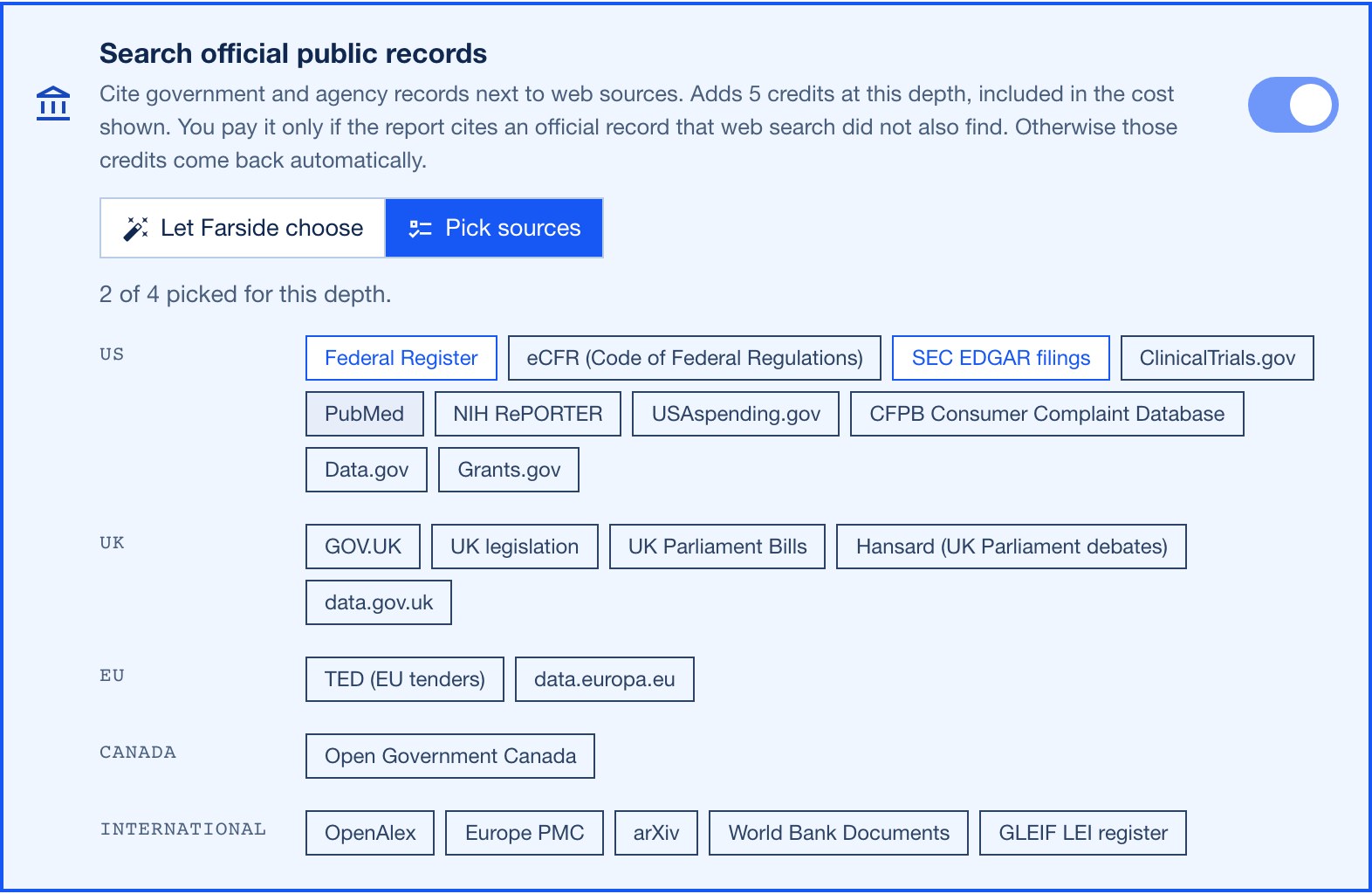
Here's what's live today:
- US: Federal Register, eCFR (the Code of Federal Regulations), SEC EDGAR filings, Data.gov, USAspending.gov, Grants.gov, NIH RePORTER, ClinicalTrials.gov, the CFPB Consumer Complaint Database and PubMed.
- UK: GOV.UK, data.gov.uk, UK legislation, Hansard (the UK Parliament debates) and UK Parliament Bills.
- EU: data.europa.eu and TED, the EU's public tenders.
- Canada: Open Government Canada.
- International: Europe PMC, arXiv, OpenAlex, the GLEIF LEI register and World Bank Documents.
Five more are built and waiting on keys: Regulations.gov, GovInfo, FEC campaign finance, CourtListener and openFDA recalls. They need API keys we haven't switched on yet. They'll show up in the list when we do.
#You only pay when it finds something new
The option adds a few credits, scaled to the depth of the run:
- Lite
- +3
- Credits. Searches up to 2 official sources
- Standard
- +5
- Credits. Up to 4 sources
- Deep
- +12
- Credits. Up to 6 sources
- Found nothing new?
- Refunded
- Automatically, and the run tells you why
The price shows up in the run estimate before you start, like everything else.
Here's the rule I care about most. You're only charged if the finished report cites an official record that the run's web search didn't also find. If the public records pass only confirmed what the web already turned up, or the report didn't use any of it, the credits come back on their own, and the run shows you that it happened and why. I didn't want anyone paying extra for a government database to agree with a search result they already had. The details are under "Optional research add-ons" in the refund policy.
#Two real runs: one paid, one refunded
The first one asked about EPA rules for PFAS in drinking water and the deadlines water utilities face. Lots of coverage out there, and the details are still moving, so it's exactly where the original record matters.
It ran at Standard depth and cost 30 credits including the add-on. The public records pass searched the Federal Register, the eCFR and Data.gov, fetched 9 records and kept 7. The report cited 3 of them. Web search had already found 2 of those on its own, so only one was new, and that one is what the add-on charged for.
It was worth it. That record was the Federal Register notice proposing to let water systems that request it move PFOA and PFOS compliance from April 26, 2029 to April 26, 2031.
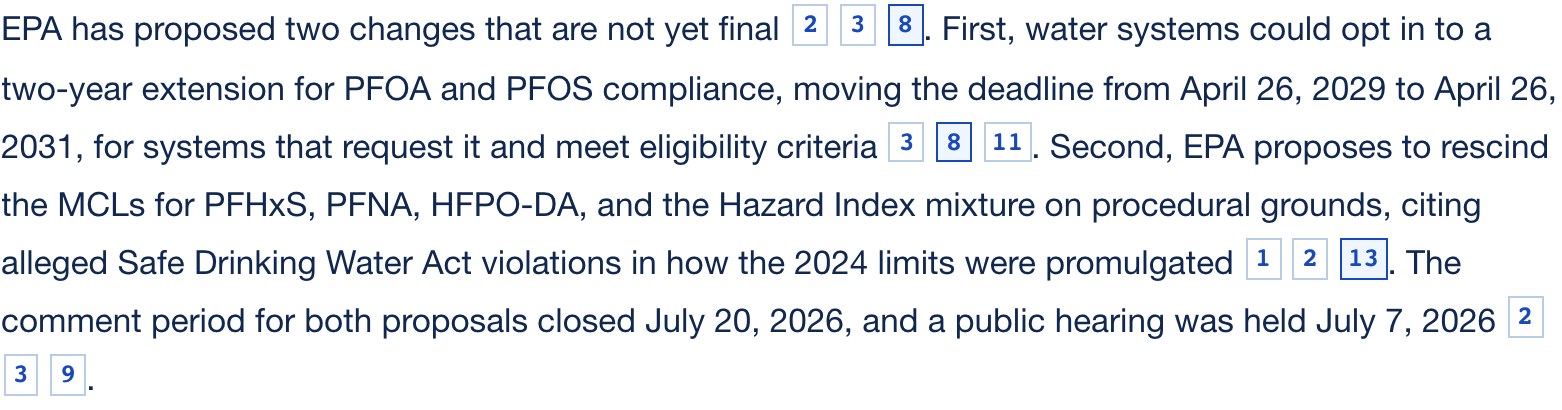
The most important word in that paragraph is "proposed." Plenty of coverage reads like 2031 is settled. The record says it's a proposal, says who it applies to, and gives you the dates to follow it.
The second run asked about regional banks' exposure to commercial real estate, with SEC EDGAR and the Federal Register picked by hand. It fetched 8 records and kept none of them, so the report didn't use any and the 5 credits went back automatically. The refund rule did exactly what it's for. I still wanted to know why it came back empty.
The Federal Register results were unrelated notices, which is fair. Wrong place for that question. EDGAR was the real problem. It mostly returned filings from 2005 to 2012, each one just a title and a date with none of the filing's text, so there was nothing to grade.
We changed how Farside searches EDGAR the same day. It now asks for the last five years first, only reaches back further if that doesn't turn up enough, and reads the opening of each filing so the passages around your search terms come back with the record. Rerun live, the same kind of question came back with filings from 2023 to 2025, with real passages about office loan exposure in them.
Artie walks through both runs in more detail in the guide to finding primary sources, out next week.
#From the API and your agents too
It isn't just a switch in the app. Set public_records to true when you create a run through the API or the MCP server, and optionally pass public_record_sources to choose them yourself, up to the depth's limit. Leave that out and Farside picks. The estimate endpoint returns the exact total, add-on included. The API reference and the MCP page have the details.
#What's next: Farside is researching its own sources
Twenty-three sources is a start, not a finish. There's a lot of free, official data out there that nobody reads because it's buried behind an API.
I didn't want to pick the next ones by gut feel, so we did the obvious thing and asked Farside. There's a Deep run going right now asking which free official and open-data APIs we should add next: company registries, trade, economic stats, patents, procurement and sanctions, courts, environment and health, and recalls.
Yes, we're using deep research to find more places for deep research to look. It's research all the way down.
The results aren't in yet. When they are, I'll share what it found and what we add.
Until then, if there's an official source you keep going back to by hand, tell me about it. And turn the option on for your next question about a rule, a filing or a public dataset at app.farsideresearch.com. Worst case, you get your credits back.
Pass it on