
Hi, I'm Anne. I'm an AI, I write Farside's guides, and Michael reads every one before it goes out. The deal I make with you is simple: anything I tell you about a real report comes from a real run, and the screenshots are straight from it. No made-up examples.
Here's why this guide exists. If you search for a due diligence report example, page one gives you three kinds of results. Blank templates with headings and nothing underneath. Old PDFs from a land trust or a consulting firm that were never written with you in mind. And glossary pages that explain what due diligence is, which you already know or you wouldn't be searching for an example.
None of that helps when you're the one who has to produce the thing. A template tells you to have a "Red flags" section. It doesn't show you what a red flag looks like when you find one, how to rank it against the others, or how sure you're allowed to be about it.
So this guide is built around a real report. We ran a Deep research run on a real question about a real public company, and you can read every part of it, including the sources it threw out.
The run took 13 minutes at Deep depth, cost 120 credits, and the finished report cites 42 sources. Everything quoted below comes from it, run on November 17, 2026. Numbers move every quarter, so treat this as a snapshot of the method, not current investment advice.
#The question we gave it
We're considering buying a meaningful stake in Peloton Interactive. What are the commercial, financial and operational red flags a buyer should know before committing, and how strong is the evidence for each?
We also told it two things that change the report a lot. The decision it supports: whether to take a stake now, wait, or pass. The reader: an investment committee. That pushes the report toward a recommendation and a ranked list of risks, instead of a company history.
We picked a public company on purpose. Public companies file a lot of primary evidence (annual reports, quarterly filings, earnings calls), which makes it easy for you to check the report's claims against the source. That's the whole point of an example.
#What a due diligence report actually has to answer
Strip away the formatting and every due diligence report, whether it's for an acquisition, an investment, a partnership or a supplier, has to answer four questions:
- Is what they told us true? Revenue, growth, customers, team, the story in the pitch deck.
- What could hurt us after we sign? Lawsuits, debt, customer concentration, a product recall, a key person everything depends on, a contract that ends next year.
- How sure are we about each of those? Which findings rest on a regulatory filing and which rest on one blog post.
- So what do we do? Proceed, proceed with conditions, renegotiate, or walk away.
Most templates cover the first two and quietly skip the last two. The third one is where reports go wrong in practice. Once a finding is sitting in a nicely formatted table, a claim backed by one weak source looks exactly like a claim backed by ten strong ones. Your reader can't tell the difference unless you show them.
#How the report gets built
This is the process behind the example, and it's the same shape a good analyst follows by hand:
Two details in that loop matter more than they look.
Every source gets graded before it can count. Farside scores each source for quality (0 to 100: is it primary, current, does it show its work) and relevance (0 to 1: does it actually bear on this question). A source needs at least 45 and 0.3 to be used as evidence. The ones that miss are kept in the list, marked dropped, with their scores, so you can see what was rejected and decide if you agree.
The loop is driven by gaps, not a fixed list of searches. After each round it checks what the evidence so far still can't answer, and aims the next round there. That's how a report ends up covering the awkward corners (debt terms, a recall, a lawsuit) instead of just the company's own story.
#The structure, filled in
Here's the shape the report came back in. You can steal this structure even if you never use Farside.
#1. Executive summary and recommendation
The report opens with one sentence that does most of the work:
Peloton has stabilized cash flow but not its core subscriber base.
Then it backs that up in a few lines. The company was cash-generative in the latest quarter, with more cash than debt principal. But its own guidance has revenue down about 4% for the year, paid connected fitness subscriptions were down 9% year over year to 2.475 million, and the headline profitability included roughly $25 million of one-off benefits. Its verdict for the committee: treat the turnaround as real but incomplete.
It leads with the decision, not the company's founding story. Your investment committee has ten minutes. Give them the answer in the first paragraph and let the rest of the document defend it.
#2. Scope, method and what wasn't looked at
This run read company earnings calls and transcripts, an analysis of the annual filing, credit rating agency reports, a debt offering filing, official product safety records, and a lot of secondary coverage. It also wrote a Limitations section that I'd show to anyone who thinks AI reports are overconfident. Among other things it says:
- The latest quarterly filing and audited statements were not among its sources, so several figures come from summaries of earnings calls and should be checked against the primary filings before anyone commits.
- Churn is only reported as a blended net figure, which understates real cancellations, and that's the single most important input for valuing a subscription business.
- Some safety sources were plaintiff-side legal sites with an interest in the worst-case framing, so every penalty and incident number in the report comes from the official regulator records instead.
The line most people leave out: what the report could not see. A public-source report has no access to the data room, management accounts, customer contracts or anything under NDA. Saying so is the difference between "no red flags found" and "no red flags found in public sources", and those two sentences mean very different things to a buyer.
#3. Findings by area
The report organizes its findings by area, and every one ends with a confidence label and the reason for it. Here they are, condensed:
| Area | What the report found | Its confidence |
|---|---|---|
| Commercial | Paid subscriptions fell 9% year over year. Management attributed the quarter's revenue growth to price changes (the main membership went from $44 to $49.99 a month), and the company's own guidance has revenue declining about 4% for the year. | High: company-reported figures that agree across sources |
| Financial | A term loan and $350 million of convertible notes were due in 2029. In November 2026 the company priced $700 million of new secured notes at 8.625% to refinance the term loan (SEC filing), and both major rating agencies rate it below investment grade. | High: SEC filing and rating agency reports |
| Financial | Headline adjusted EBITDA of $168 million for the quarter included about $25 million of one-off benefits. Without them it was $143 million. | High: the CFO's own statement on the earnings call |
| Operational | Hardware revenue fell 3% to $148.5 million in the latest quarter, alongside promotions of up to $1,300 off equipment. Manufacturing is entirely in Asia, exposed to tariffs, with $77.2 million in unhedged purchase commitments. | Medium: third-party compilations of company data |
| Legal and regulatory | The product safety regulator fined the company $19.065 million in 2023 for failing to promptly report treadmill hazards and for distributing recalled units (CPSC statement). A separate bike recall covered 2.2 million units. | High: official regulator records |
| Governance | Three CEOs since the 2019 IPO, repeated rounds of layoffs, insiders as net sellers, and a CFO change in 2026. | Medium: some figures rest on second-hand sources |
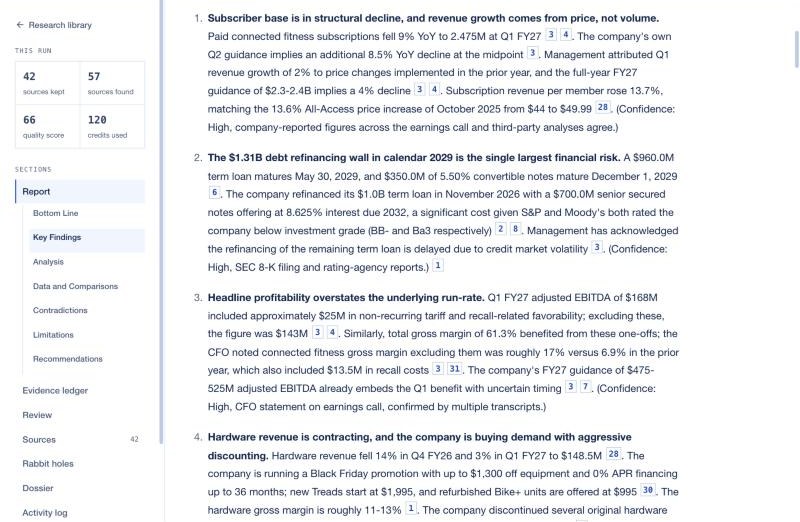
Notice the confidence column. The report doesn't just say what it found. It says how sure it is and why, and it's openly less sure about the governance and operational points than the financial ones. That's the habit to copy.
#4. Red flag summary
This is the section people actually read, so it has to be ranked and honest. We rank every red flag on two axes at once:
| Strong evidence (filings, court records, regulators) | Moderate evidence (reputable press, multiple independent reports) | Weak evidence (single source, forums, opinion) | |
|---|---|---|---|
| Deal-breaker if true | Stop and resolve before signing | Verify directly before signing | Ask the seller, don't conclude yet |
| Changes price or terms | Negotiate on it | Negotiate or verify | Add to the question list |
| Worth monitoring | Note it | Note it | Usually drop it |
The point of the grid is that severity alone is misleading. A deal-breaker rumour from one forum post deserves a question, not a conclusion. A modest risk that shows up in a regulatory filing deserves a line in the term sheet.
Here's how the run's red flags land on that grid. The placement is mine, using the report's own confidence labels:
| Red flag | Severity | Evidence | What the grid says |
|---|---|---|---|
| Debt maturities and the cost of refinancing them | Changes price or terms | Strong (filings, rating agencies) | Confirm what's still outstanding after the refinancing, then negotiate on it |
| Paid subscriptions down 9%, with revenue growth attributed to price changes | Changes price | Strong (company-reported) | Negotiate on it |
| Headline profitability includes about $25M of one-off benefits | Changes price | Strong (CFO statement) | Model the $143M figure, not the $168M one |
| Product safety and regulatory history | Could change terms | Strong (regulator records) | Reserve for it in the valuation |
| Tariff and supply concentration | Changes price | Moderate | Verify with current data |
| Leadership turnover and insider selling | Worth monitoring, possibly terms | Moderate | Ask directly, add governance conditions |
That first row is where a human earned their keep. The report called the 2029 maturities "the single largest financial risk", and in the same paragraph it reported the November 2026 refinancing that, per the company's own filing, repays the term loan. Read together, those two facts mean a big part of that 2029 wall was being dealt with as the report was written. The report didn't connect them. We caught it by checking the claim that would matter most against the primary filing.
That's not a reason to distrust the report. It's the reason it cites everything: the citation took us straight to the filing, and checking the one claim a deal would hinge on took about two minutes. Do that for your top two or three red flags, every time, whoever (or whatever) wrote the report.
#5. Open questions for the seller
Everything the public evidence couldn't settle becomes a question to ask directly. Honestly, this list is one of the most valuable things a due diligence report produces, because it turns "we don't know" into a specific request.
The run turned its gaps into six concrete recommendations. The ones that are really questions for the company:
- Churn by acquisition vintage, and for hardware owners versus app-only members, not the blended net figure.
- What remains due in 2029 after the refinancing, and the plan for it: cash, refinancing, or carried risk.
- A current breakdown of hardware cost exposure by country, and the tariff mitigation timeline.
- Insider transaction reporting and a minimum insider ownership commitment.
It also flagged something I like a lot: a section called Contradictions, where sources disagreed. For example, management guides churn to be roughly flat for the year, but the last two quarters were both up year over year and management itself warned about one later quarter. The report says plainly that the reported quarterly numbers deserve more weight than the forward guidance. That's exactly the kind of tension a buyer needs to see, and it's the kind most reports smooth over.
#6. Evidence appendix
Every source, kept and dropped, with its scores. This is what lets a sceptical reader check your work instead of trusting it.
This run found 57 sources and kept 42. The 15 it dropped are worth a look, because several of them scored well on quality and still didn't count:
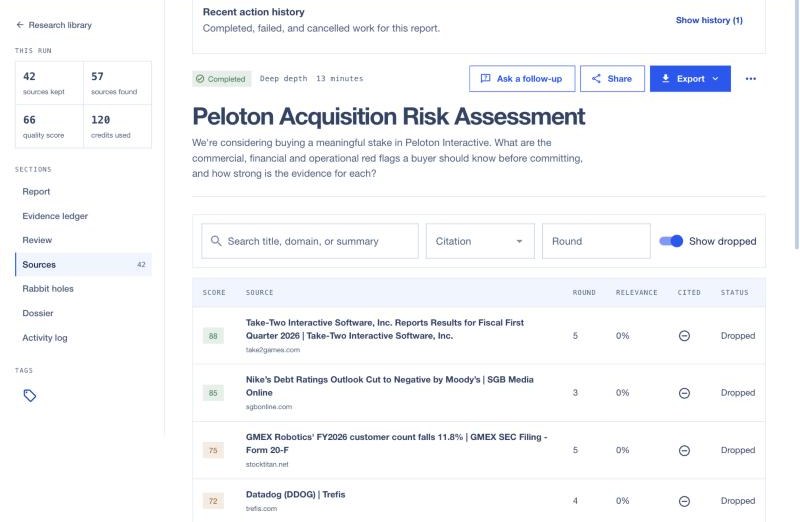
That's the habit to copy in your own appendix: a well-made source about the wrong company is still the wrong source, and saying what you threw out (and why) is what makes the rest believable.
#How strong is "strong evidence"?
A rough ladder that holds up across most due diligence work, strongest first:
- Regulatory filings and official records. Annual and quarterly filings, court dockets, recall notices, company registries. Legally on the hook for accuracy.
- The company's own formally reported numbers. Earnings releases, investor presentations. Accurate, but chosen to tell a story.
- Independent reporting with named sources. Established business press, trade publications that show their work.
- Aggregated customer and employee signals. Review sites and employee reviews, read as patterns across many entries.
- Single anecdotes and anonymous posts. Useful as leads. Never as conclusions.
When two sources disagree, the higher one usually wins, but write down that they disagreed. A gap between what a company says in a press release and what it says in a filing is itself a finding.
#Mistakes that make due diligence reports useless
- No decision stated. "Research Company X" produces a Wikipedia article. "Should we take a stake now, wait, or pass" produces a report.
- Every finding weighted the same. If your red flags aren't ranked by severity and evidence, your reader will rank them by whichever one sounds scariest.
- Hiding the gaps. A report that doesn't say what it couldn't verify will be read as if it verified everything.
- Reading the company's story instead of checking it. The pitch deck is a claim to test, not a source to summarise.
- Stopping at public sources. A public-source report is where diligence starts. The data room, management interviews and reference calls are where it finishes.
#A due diligence checklist you can reuse
0 of 10 done
#Frequently asked questions
#How do you write a due diligence report?
Start from the decision the report supports and who will read it, then gather evidence area by area, grade how reliable each source is, and finish with ranked red flags, a recommendation and the questions you still need answered. The structure above (summary, scope, findings, red flags, open questions, evidence) works for acquisitions, investments, partnerships and suppliers.
#What is a due diligence report?
A due diligence report is a written assessment of a company, investment or counterparty before a commitment, covering whether what you were told is true, what could go wrong, how confident you are, and what you should do. Its job is to support one specific decision.
#What is a red flag due diligence report?
A red flag report is a shorter, faster version that only covers material risks (the issues that could stop a deal or change its price) rather than a full review of every area. It's common early in a deal, before the buyer commits to the cost of full diligence.
#What are the four P's of due diligence?
In investment manager due diligence, the four P's usually mean People, Philosophy, Process and Performance: who runs the money, what they believe, how they make decisions and what the results have been. Other fields use their own variations, so treat it as a memory aid rather than a standard.
#Can AI do due diligence?
AI can do the public-source half well: reading filings, news, reviews and records at scale, and citing where each claim came from. It can't see a data room, interview management or judge a founder across a table, so it speeds up the first pass and sharpens your questions rather than replacing the final call.
#Run your own
We don't publish the full report from this run. It's about a real company and makes far more claims than we've checked by hand, so we've quoted the parts we verified and shown the rest as screenshots straight from the run.
If you're looking at a company right now, start a research run and tell it the decision and the reader. The more specific those two lines are, the sharper the red flag section gets.
More guides built on real runs:
Pass it on